josephcaruana/ August 16, 2026/ Uncategorised/ 1 comments
This is my account of the eclipse of 12th August, 2026, whose path of totality included Greenland, Iceland, Northern Portugal, and parts of Spain. Our group, which included two other astronomers, observed the eclipse from Canalejas de Peñafiel (province of Valladolid) in Spain. Before we proceed to the images themselves, below I’ve written a basic description about the sun’s composition for the uninitiated, as I’ll be mentioning these terms as we go along. If you’re already familiar with the terminology, then you may skip this section and proceed directly to the next.
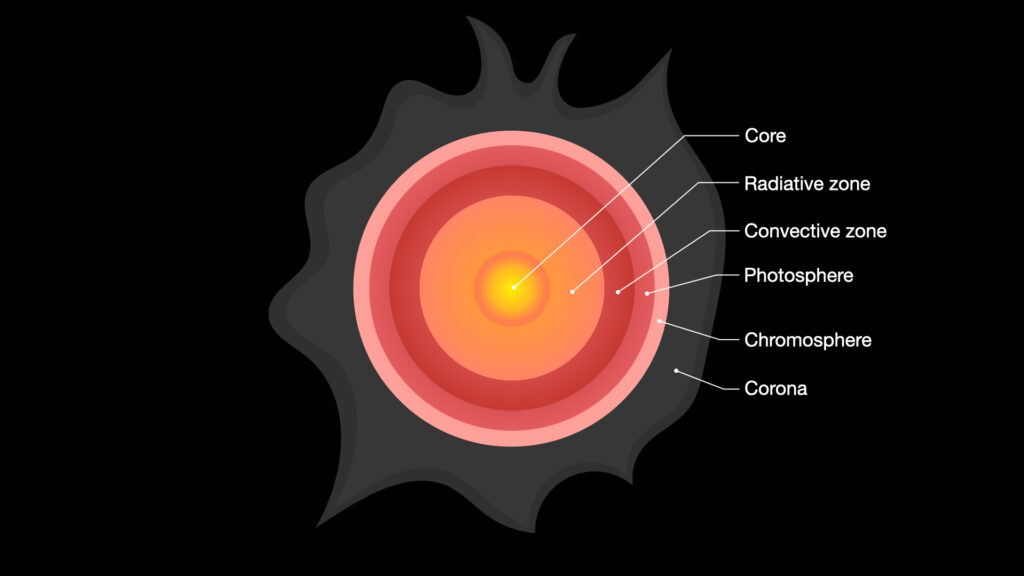
The Sun's Composition
The sun is a star; it appears much larger – and we can also feel its heat – simply because it’s much closer to us than any other star. If you could pull one of the other stars from the night sky and bring it closer, we’d have two suns in the sky.
The Sun is a giant sphere of extremely hot gas, made up primarily of hydrogen and helium, with small amounts of heavier elements (such as oxygen, carbon, and iron). At its centre lies the core, where temperatures reach about 15 million degrees Celsius. Here, enormous pressure forces hydrogen atoms to fuse together, forming helium and in the process releasing vast amounts of energy. It is this energy that powers the Sun, providing the light and heat that make life on Earth possible. Surrounding the core is the radiative zone, where energy slowly works its way outward. Instead of traveling in a straight line, photons – that is, the particles of light – take what is termed a “random walk” as they are repeatedly absorbed and re-emitted by dense gas, such that it can take hundreds of thousands of years for energy to pass through this region.
Beyond the radiative zone is the convective zone, where the gas is cooler and less dense. Here, hot plasma rises toward the surface while cooler plasma sinks, creating giant convection currents akin to the bubbling motion observed in a pot of boiling water. The visible “surface” of the Sun is called the photosphere, where most of the sunlight we see is emitted. Above the photosphere lies the chromosphere, a thin layer that appears reddish during a total solar eclipse because of glowing hydrogen gas. The Sun’s outermost layer is the corona, an incredibly hot, faint atmosphere that extends millions of kilometers into space. Although much less dense than the layers below, the corona can reach temperatures of over a million degrees Celsius and is the source of the solar wind – a constant stream of charged particles that flows throughout the Solar System.
The Sun is a dynamic and ever-changing star, with its magnetic field creating a variety of fascinating features on and above its surface. Active regions are areas where the magnetic field is especially strong, often giving rise to sunspots, which appear as dark patches on the photosphere. They sport a dark central region called the umbra, which is surrounded by a lighter area. Although they look dark compared to the surrounding surface, sunspots are still extremely hot; the umbra is typically around 3,500-4,500 degrees Celsius. However, they are cooler than the surrounding photosphere because concentrated, intense magnetic fields suppress the upward flow of heat. Active regions can also produce powerful solar flares and eruptions. One of the most striking features associated with these regions is the prominence: a huge loop or arch of glowing plasma held high above the Sun’s surface by magnetic fields. Some prominences remain stable for days or even weeks, while others erupt into space, contributing to the stream of charged particles that can produce beautiful auroras and, at times, disrupt satellites, communications, and power grids on Earth.
Observing and Photographing the 2026 Solar Eclipse
Preparations for the eclipse were made several months prior. I tried to travel light, packing only what was required. Some of our party had already arrived in Canalejas de Peñafiel, and they had identified a great spot very close to the house where we were staying. However, I had some worries that some streetlights (and the lights of the village church) would automatically come on during totality. We tried to ascertain whether the luminaires used a light sensor – and if so, whether they would (or could) be deactivated by someone for the eclipse – but we did not manage to find a person sufficiently knowledgeable about the matter. Moreover, it seemed like a crowd would be gathering at this very site, and the prospect of someone knocking the camera tripod or accidentally obstructing the view during totality was not an enticing one. Therefore, on the evening of the day prior, we scouted for a new location, and decided to switch to a new site – a field away from any human activity, with no streetlights to bother us. The Milky Way was readily visible at night; nonetheless, we could readily observe that the air was quite hazy. Wildfires to the south of our location, combined with the dry summer conditions that prevented rain from clearing dust and aerosols from the atmosphere, reduced atmospheric transparency. Sunset that evening was quite red.
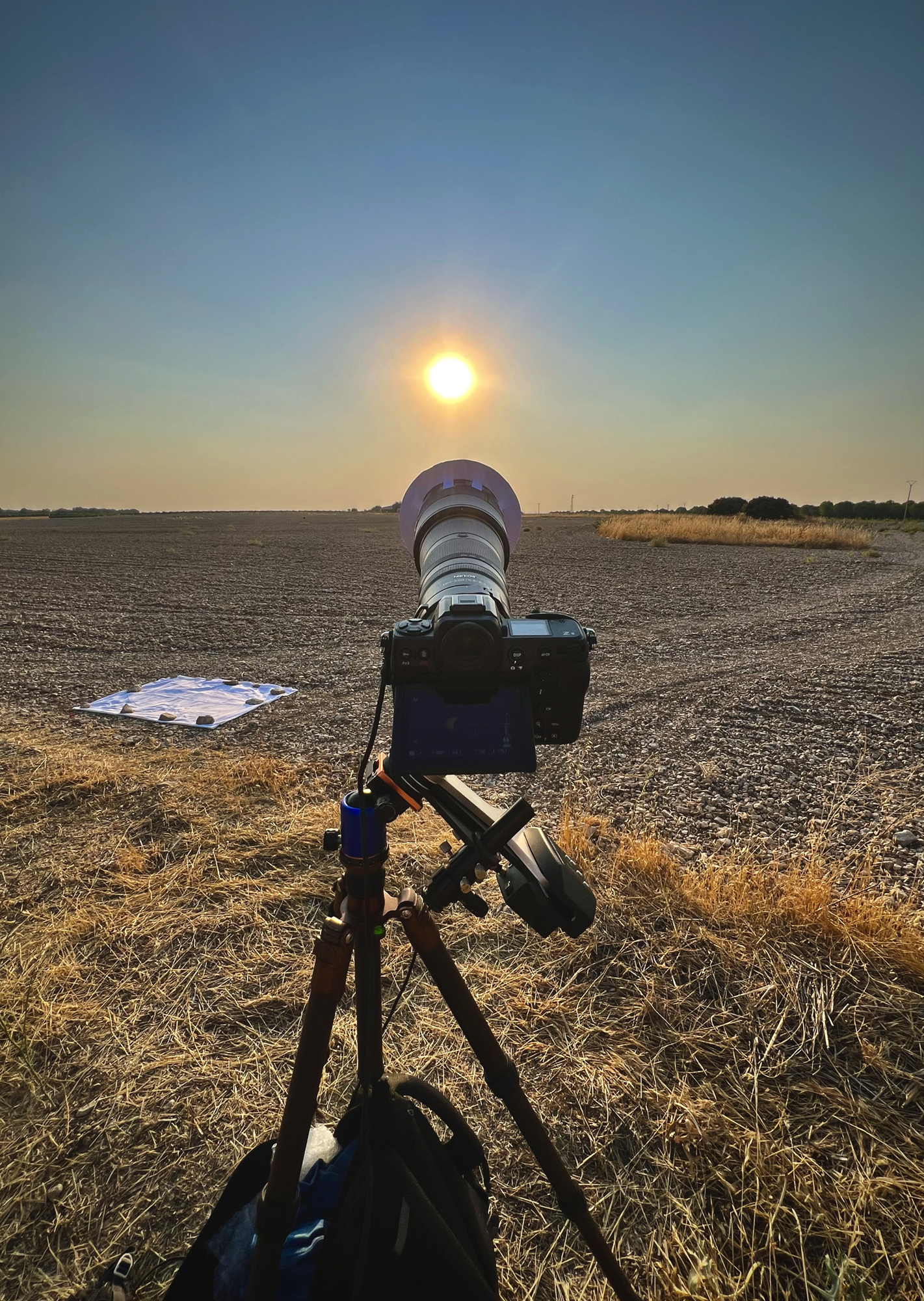
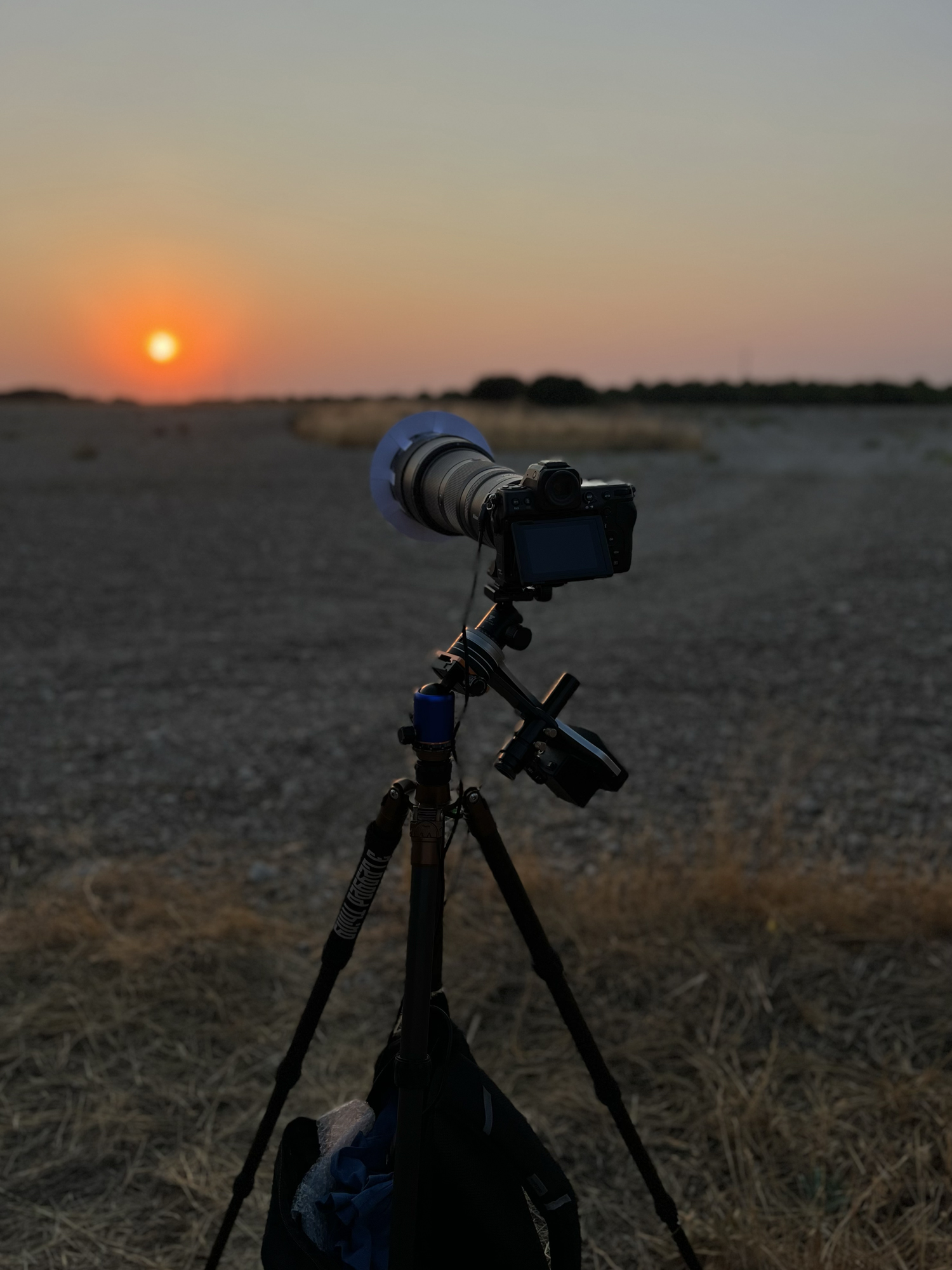
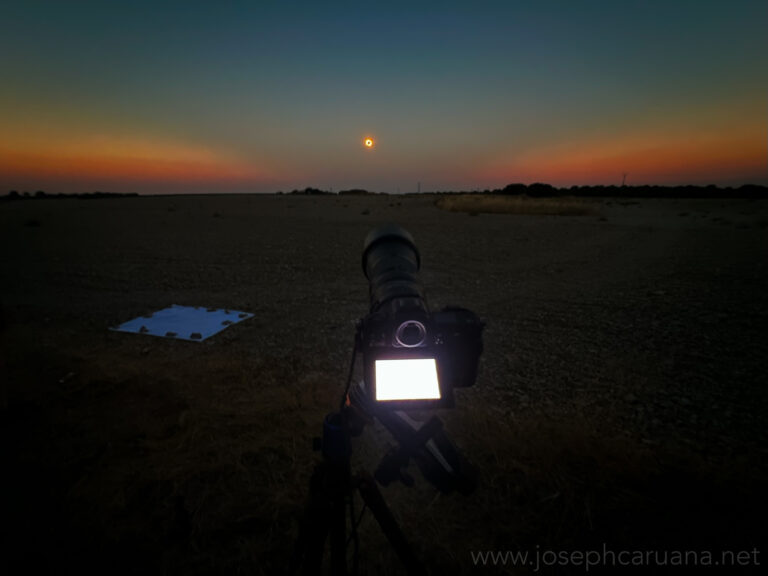
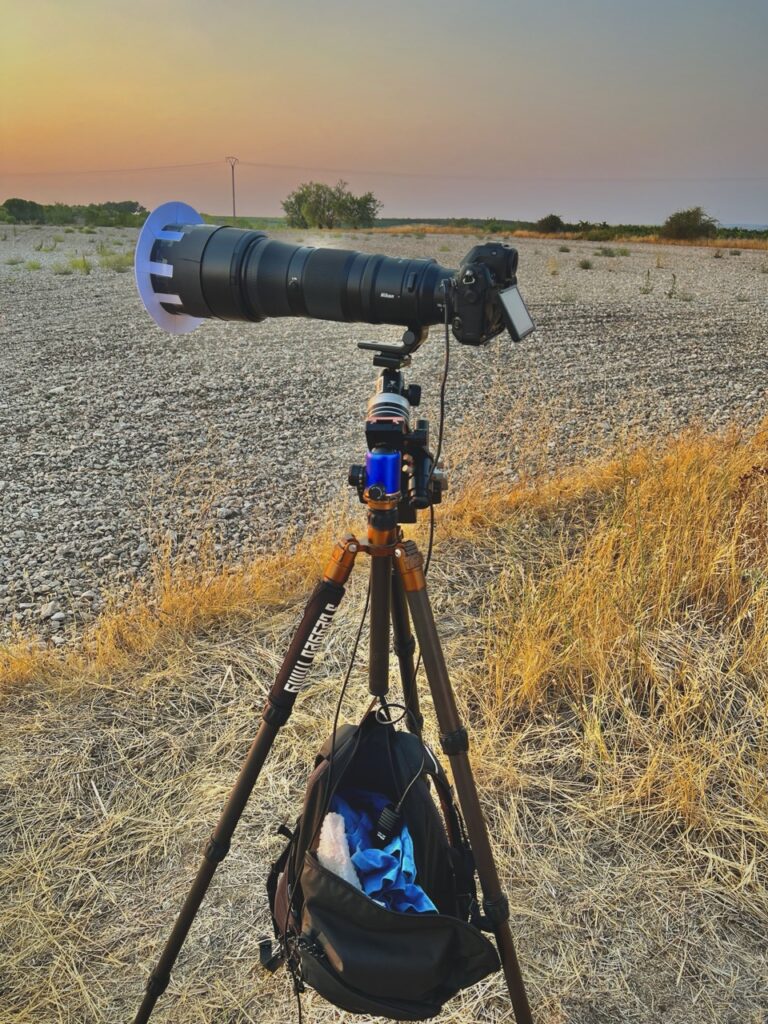
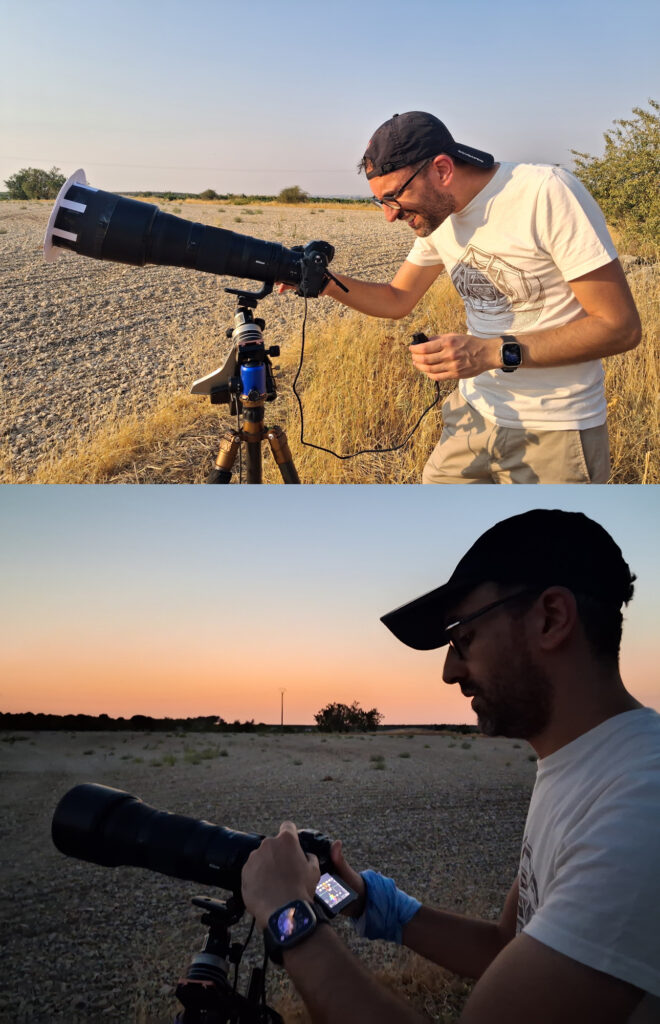
On the morning of the eclipse, four of us scouted a bit more just in case, but we decided to stick to the site chosen the previous evening. Around half an hour before the start of the partial phase of the eclipse, I set up my equipment: a Nikon Z8 and Nikkor 180-600 mm Super-Tele Zoom lens, my trusty (3 Legged Thing) tripod, and a Fornax LighTrack II to track the sun in the sky. Since, of course, there were no stars visible at this time of day, I carried out an approximate polar alignment (by aligning the mount with true north and the altitude of the north celestial pole for my latitude). The below two images are quick snapshots captured with my phone (taken at different times) showing the setup in use. (A note about the eclipse images: the files uploaded on this page are compressed versions in SRGB colour space; consequently, they do not capture the full colour gamut and subtle gradations present in the originals.)
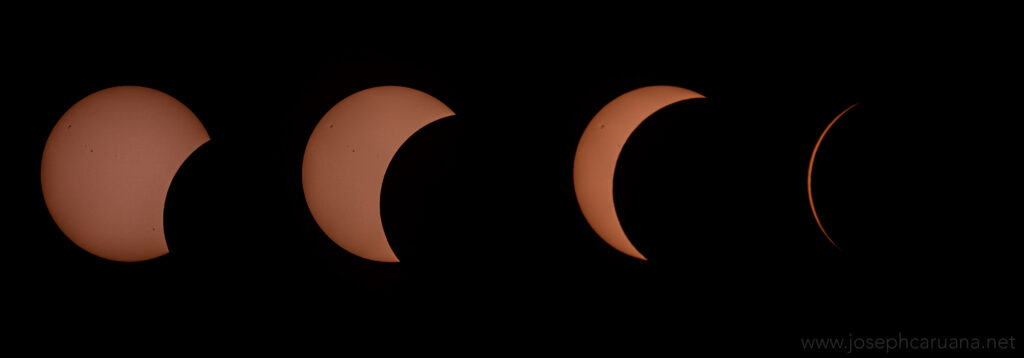
After checking that the mount was indeed tracking satisfactorily, I started to relax a bit. The eclipse had just commenced, so I began snapping away, as the Moon bit ever larger chunks out of the Sun. One of us laid a white sheet on the ground (visible to the left of the camera in the picture on the left, above), in case we’d be able to observe shadow bands before/after totality.
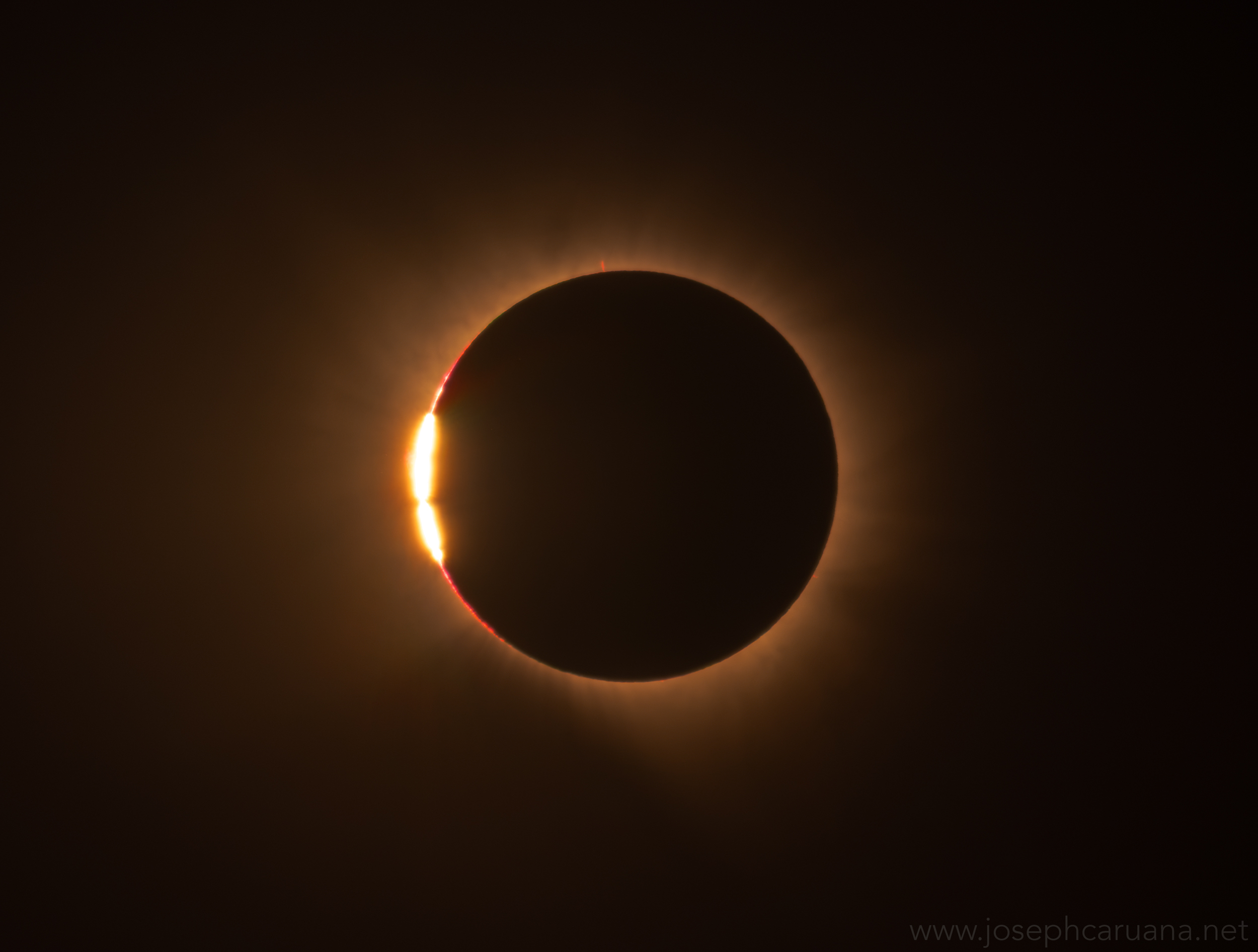
As totality approached, our excitement reached fever-pitch. The light around us dimmed dramatically, birds started chirping, and the temperature dropped. I expected the Diamond Ring effect any moment now.* Therefore, I removed the solar filter, making sure to cover the lens with my body to protect the sensor. I quickly switched settings, remote-release at the ready. The moment I looked back up at the sky, there it was! Nothing had quite prepared me for that sight: a black hole seemed to have been punched in the late afternoon sky, with a prominent burst of light to the left and a ring of fire surrounding the entire disc; quite literally, the appearance of a diamond ring in the sky! In my recollection, the ambient light almost seemed to flicker. I quickly stepped aside and pressed the remote-release, the camera rattling away.
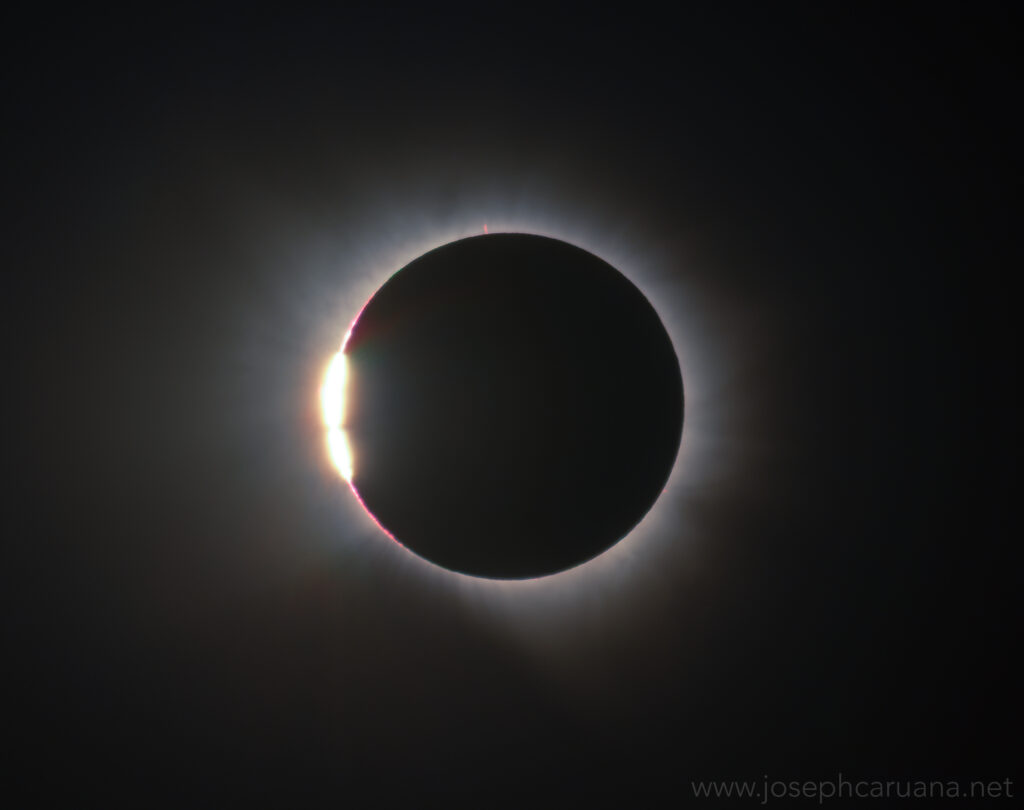
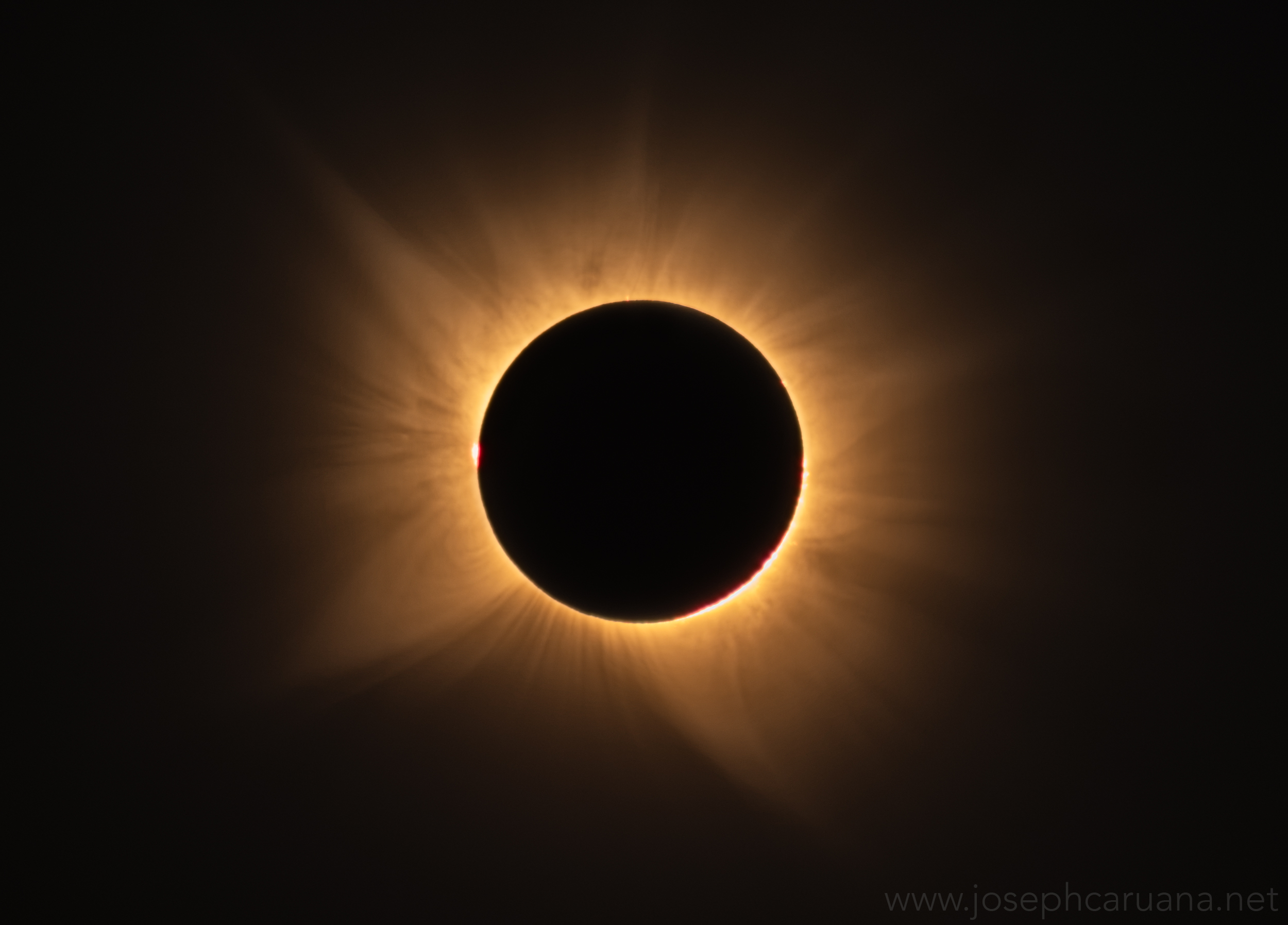
The dusty air and the low altitude of the Sun at the time cast a warm hue upon this eclipse. Visually (and one could say photographically also), this made for an even more impressive sight. However, to help visualise what the eclipse could have looked like had sky transparency been higher, I have also processed the data differently to approach true colour, removing the veil that imbued this eclipse with this yellow tint, so to speak. The below image is from the same data as above, but processed differently.
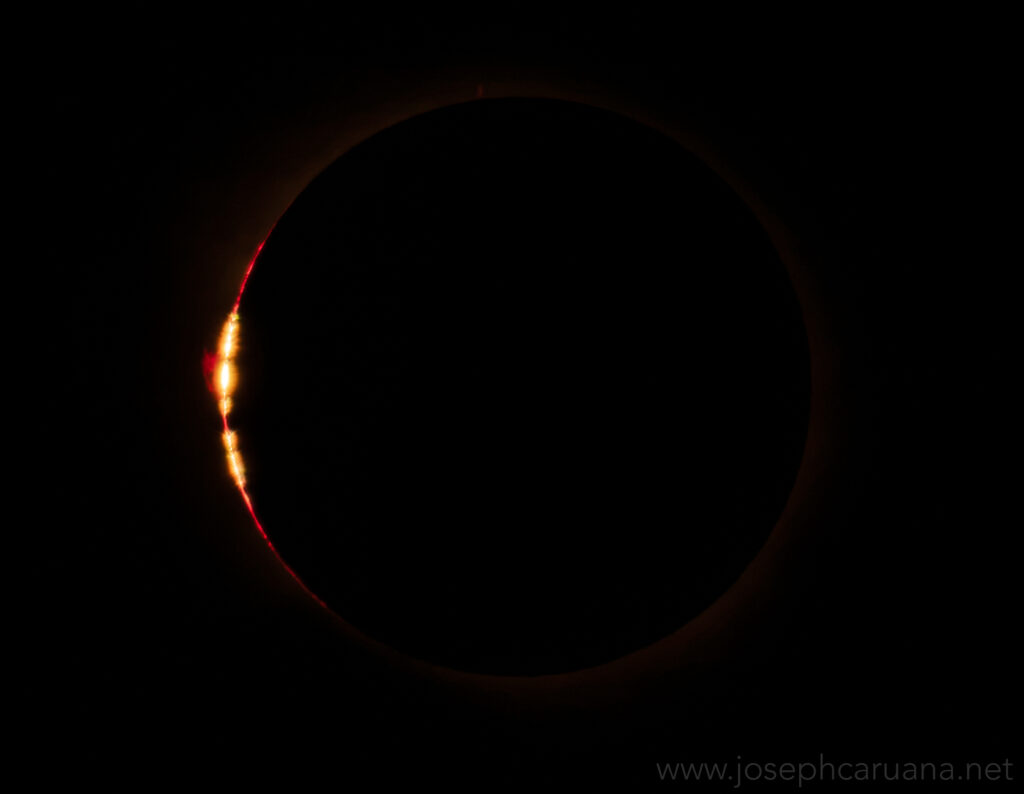
Next, the Moon’s rugged silhouette gave rise to Baily’s beads, as the Sun’s final rays slipped through its jagged valleys, each fleeting gap sparkling like a jewel along the lunar edge. The following two images (which vary in exposure time) show this phenomenon. In the first, we get our first glimpse of a majestic solar prominence on the left, which was distinctly visible and a beautiful feature of this eclipse. (More on this later.)
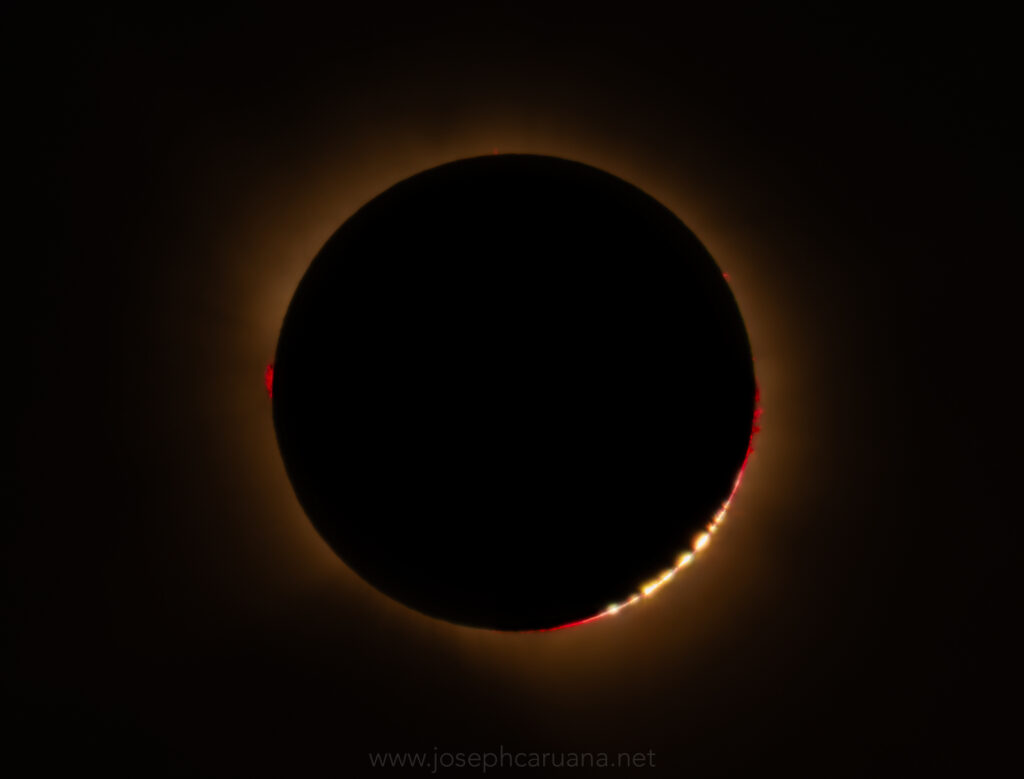
Next came what we were all waiting for – totality! It appeared as if a dark chasm had opened up in the sky, with a ring of fire surrounding it. It was a jaw-dropping sight, and no matter how much you may think you are prepared for it, you simply aren’t. The below image captures the sight; the data that was collected allowed for coronal structure to be discerned quite clearly. Notice the arch-shaped structures (bottom left) that form where magnetic field lines emerge from one active region and descend into another. The Sun is currently heading for its next quiet phase (the solar minimum) in 2030/31, so the corona is getting smaller.
In the below image captured with my phone, one can see how the sky is dark towards the centre of the frame and brighter on either side. This is because the Moon’s shadow cone lies right in front of us at the time of the total eclipse.
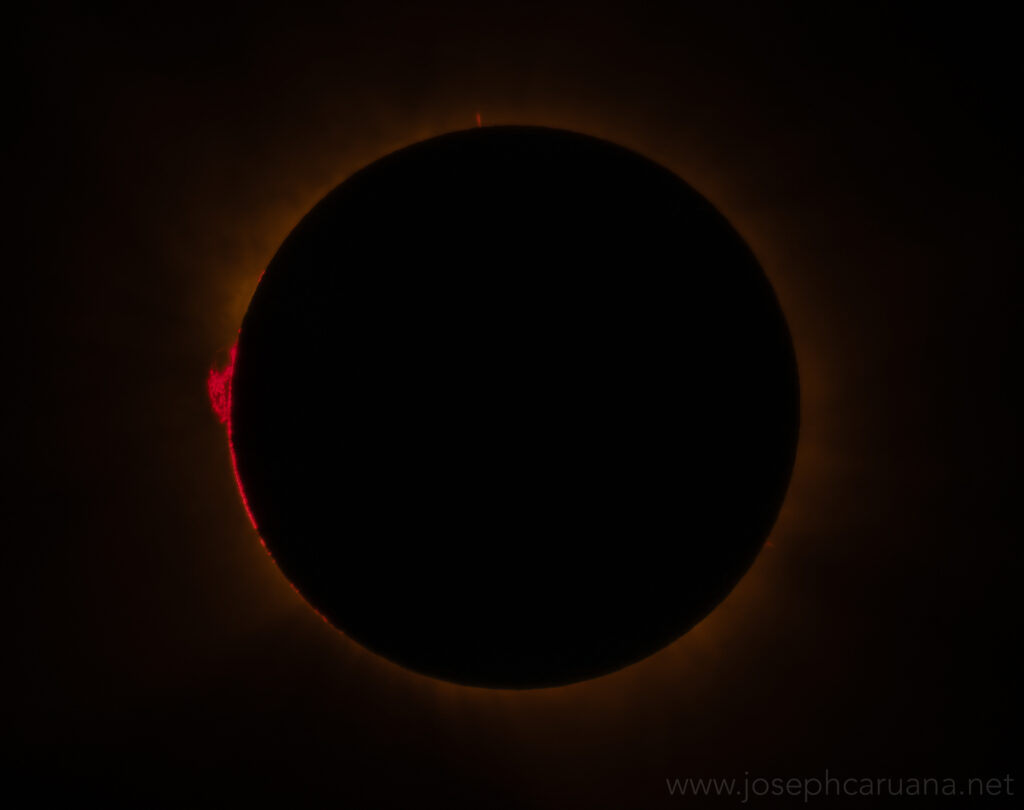
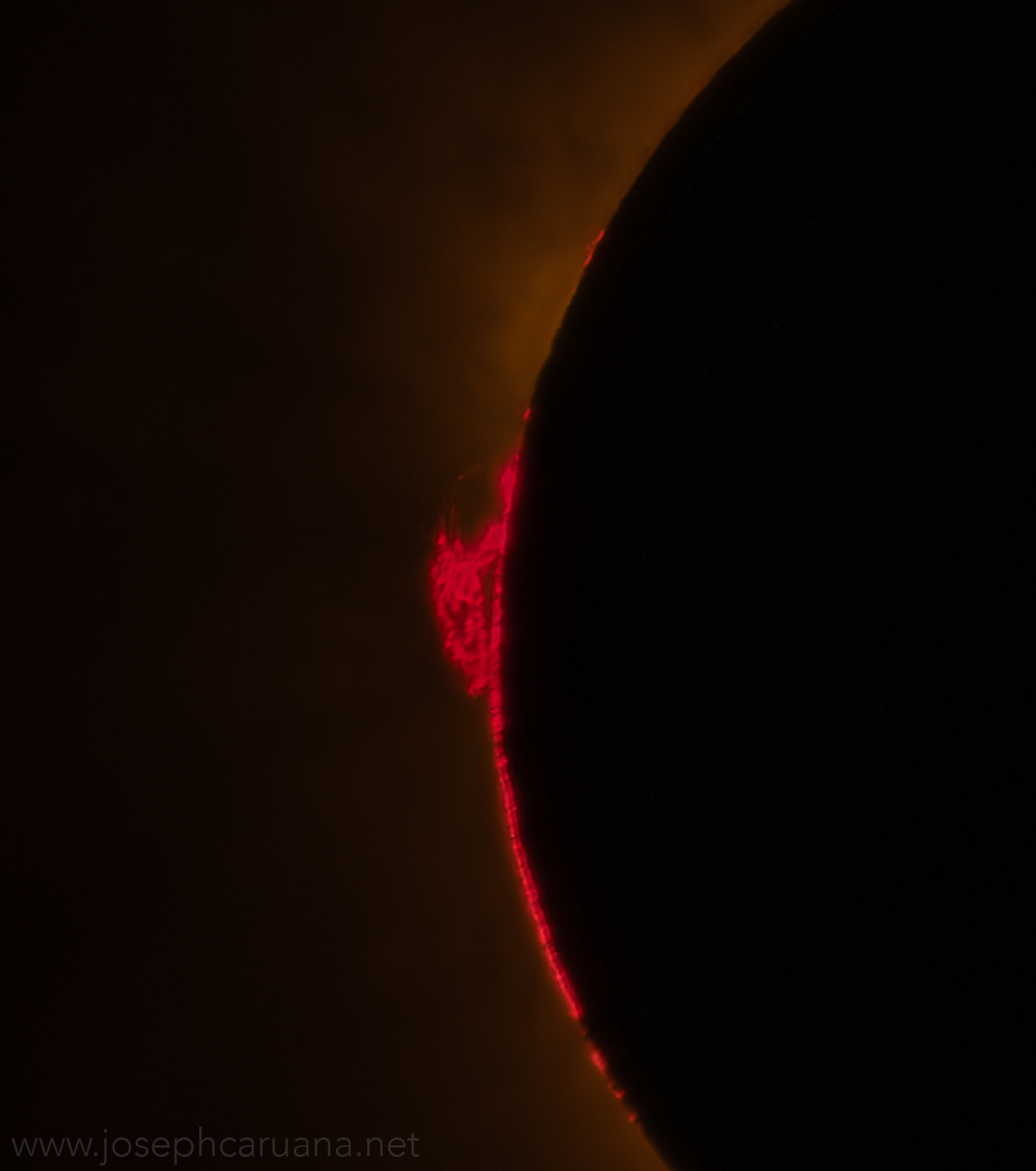
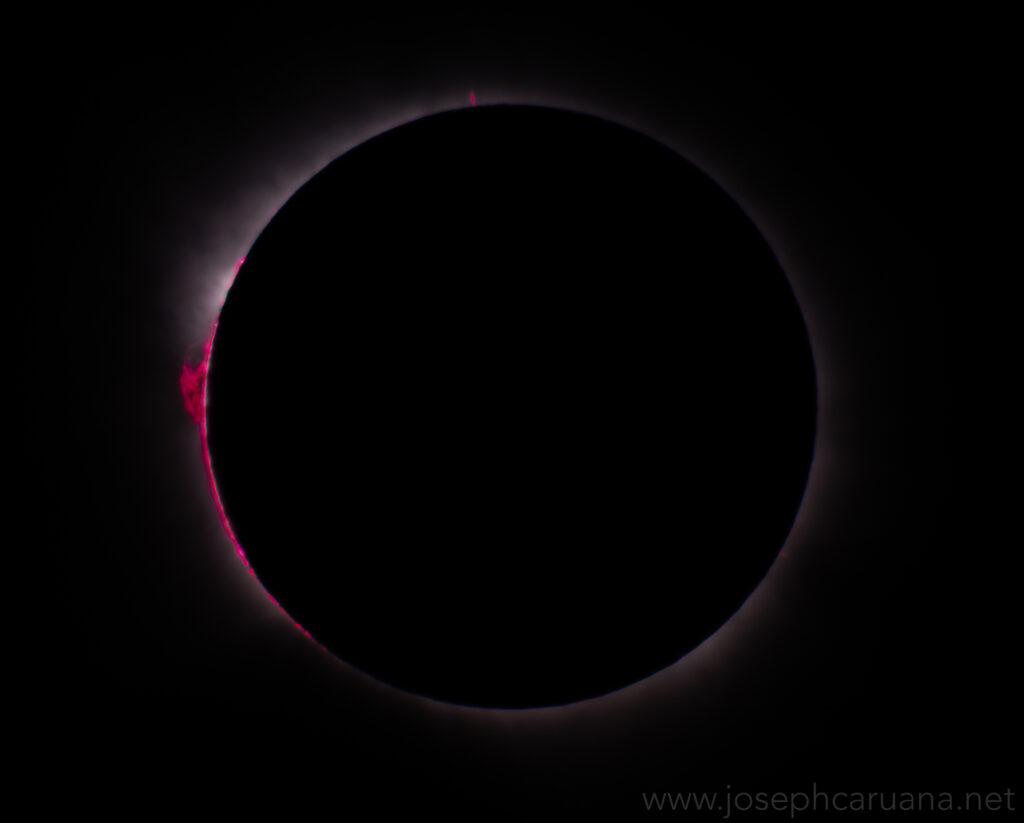
Totality is the time to capture the chromosphere and solar prominences (using an appropriate exposure time). The below image does this. The prominence on the left, which I mentioned earlier, is beautifully on display here, with an arc of red chromosphere below it. A much smaller prominence is visible at the top of the solar disc.
Below, I’m including a zoomed-in version of the above image, to better appreciate the structure in the large prominence that characterised this eclipse.
Like I did for the diamond ring above, I have produced another version of the above image that removes the yellow cast.
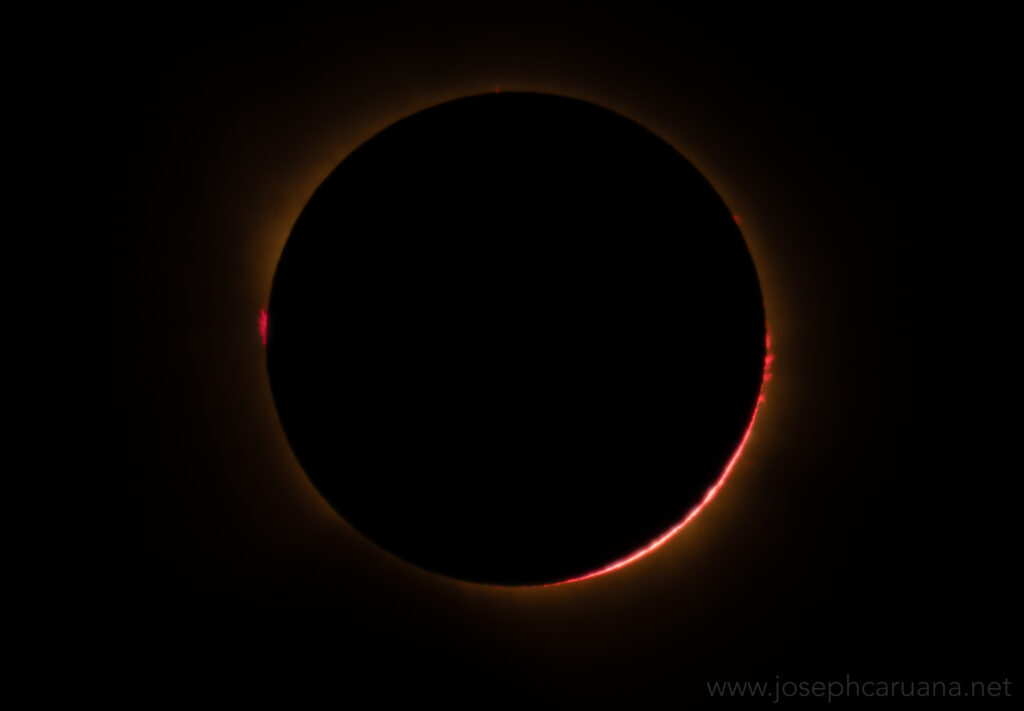
As the Moon swiftly moved across the Sun, the left side of the solar disc started getting obscured as the right side was revealed. This allowed for some captures of the chromosphere on the right, as per the below image.
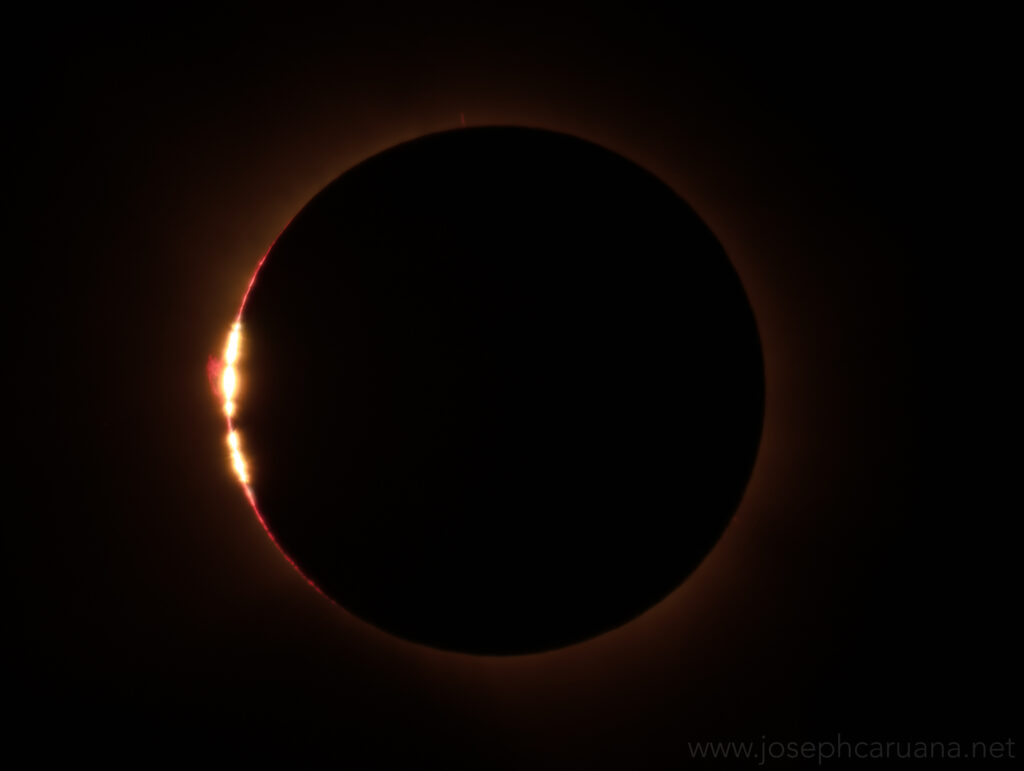
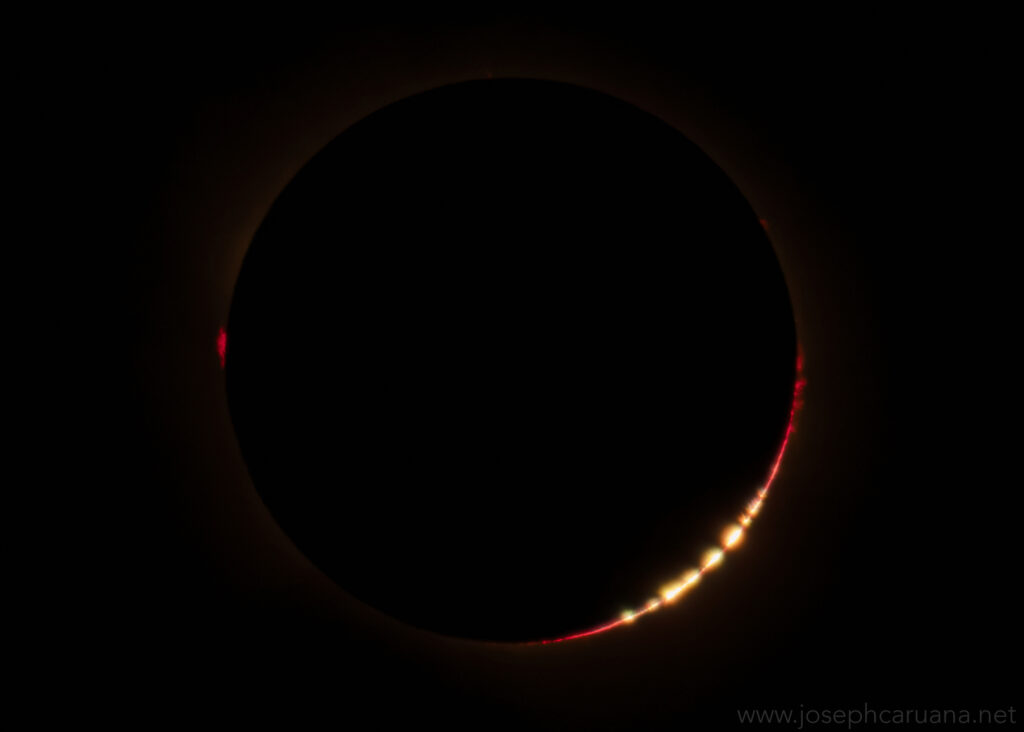
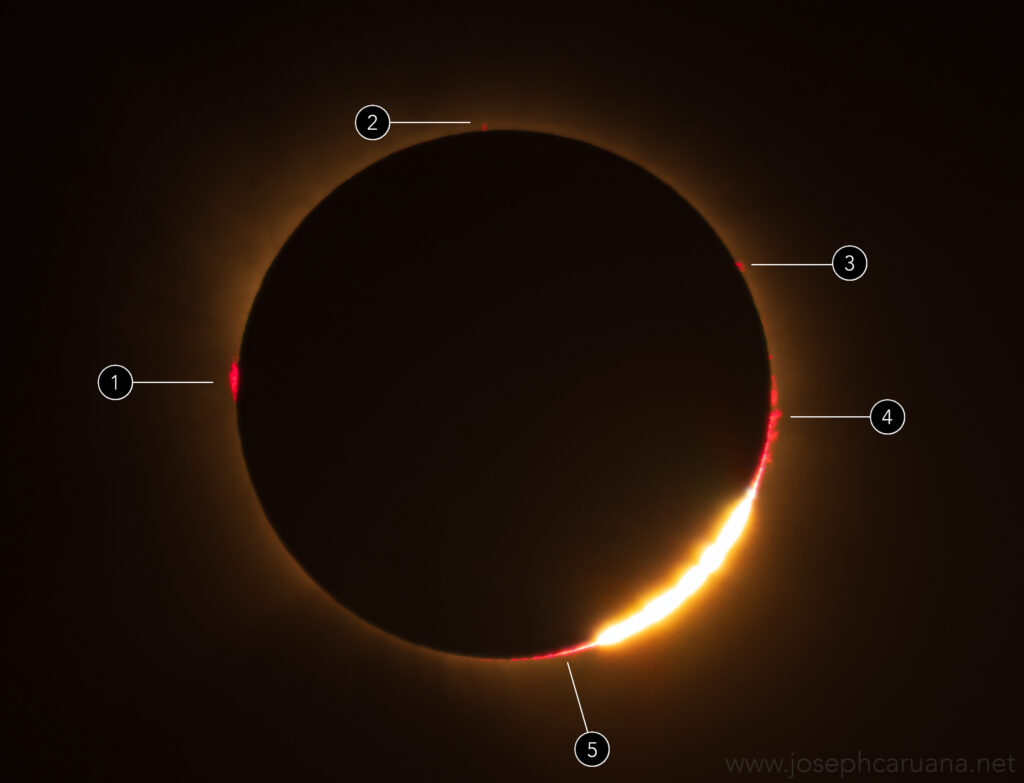
As totality approached its end, I anticipated Baily’s beads to make an appearance on the other side. In a single exposure just before this occurred, the camera recorded the uneven surface of the moon juxtaposed against the dazzlingly bright solar disc.
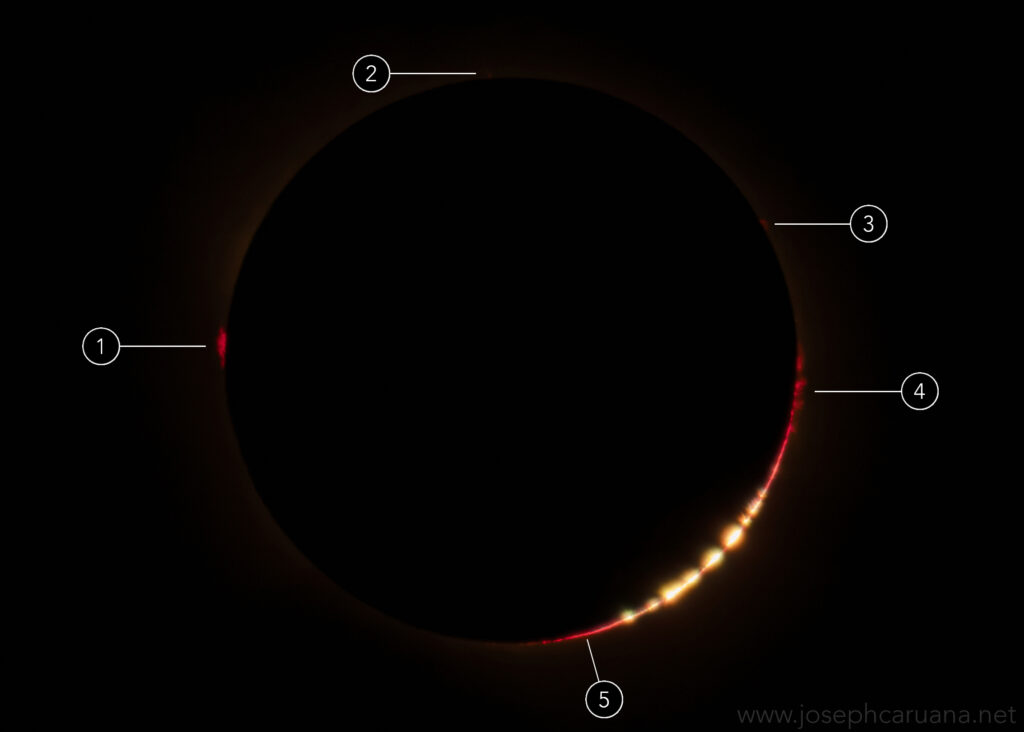
Baily’s beads were fantastic – in my view, even more stunning than the ones that appeared during the moon’s ingress.
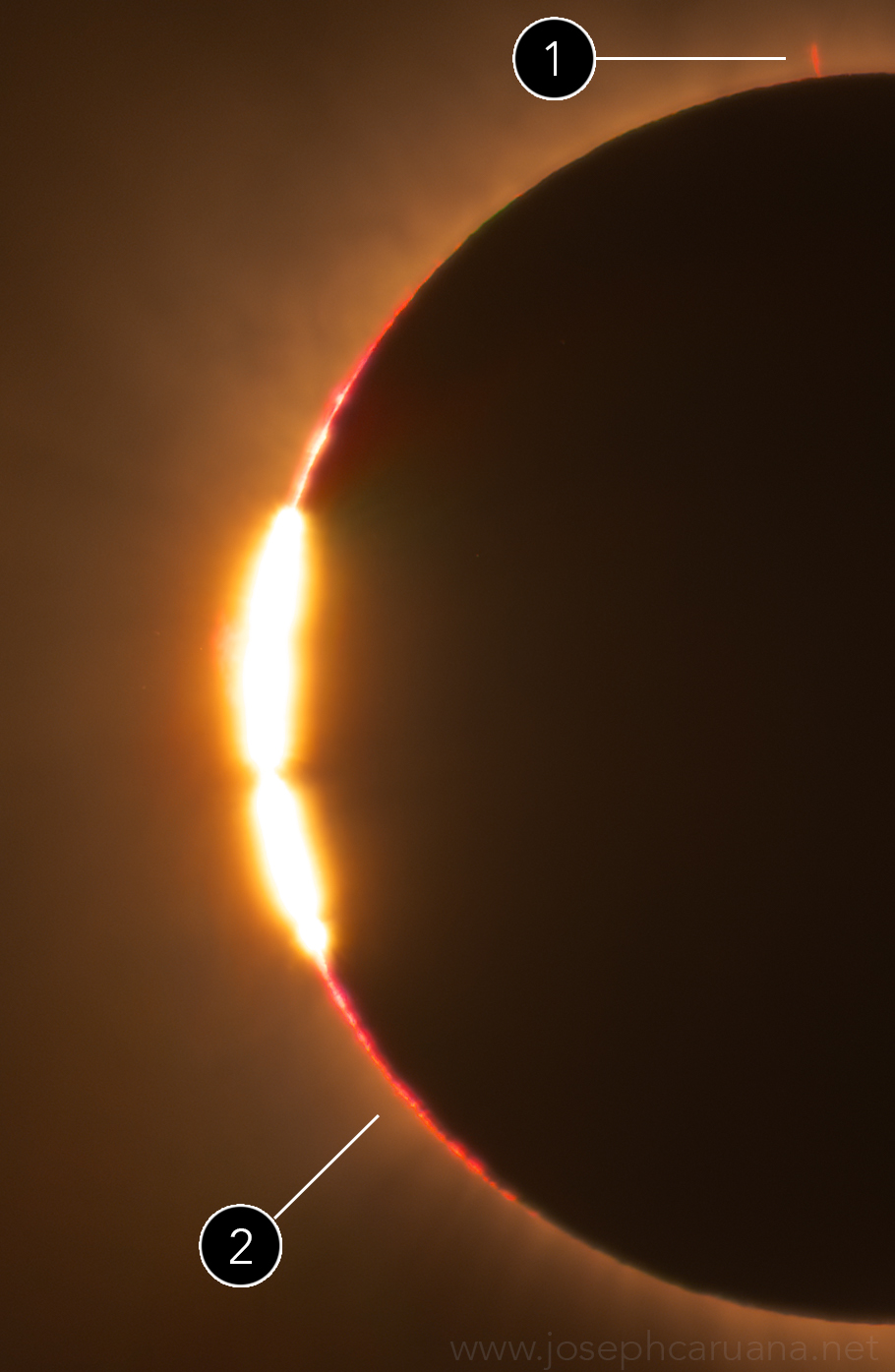
It wasn’t just Baily’s beads that were visible though. Above them, there still were the prominences I’ve mentioned before. The below image is a labelled version of the above.
Since the corona is much brighter than Baily’s beads, the dynamic range is very wide; in the above image I exposed for Baily’s beads, and as a consequence, the corona is only dimly visible. The below image is a stack of two exposures taken in rapid succession; the first is the same image shown above; the second is a longer exposure one that reveals the corona. In this way, we can view both Baily’s beads and the corona.
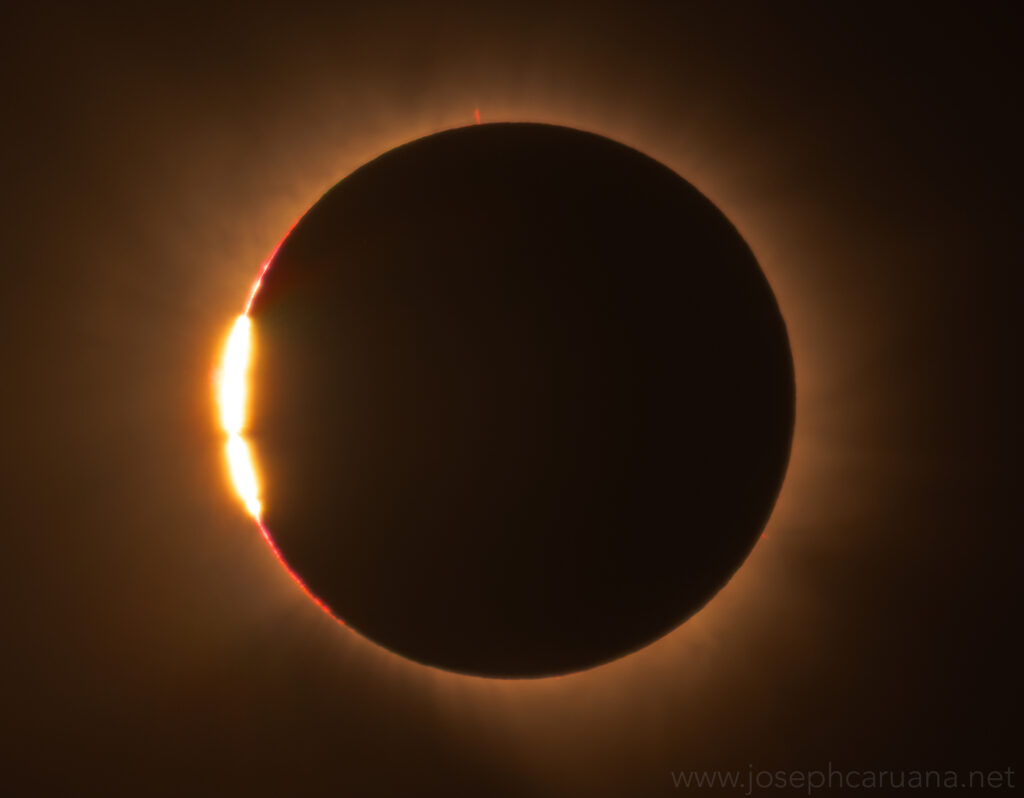
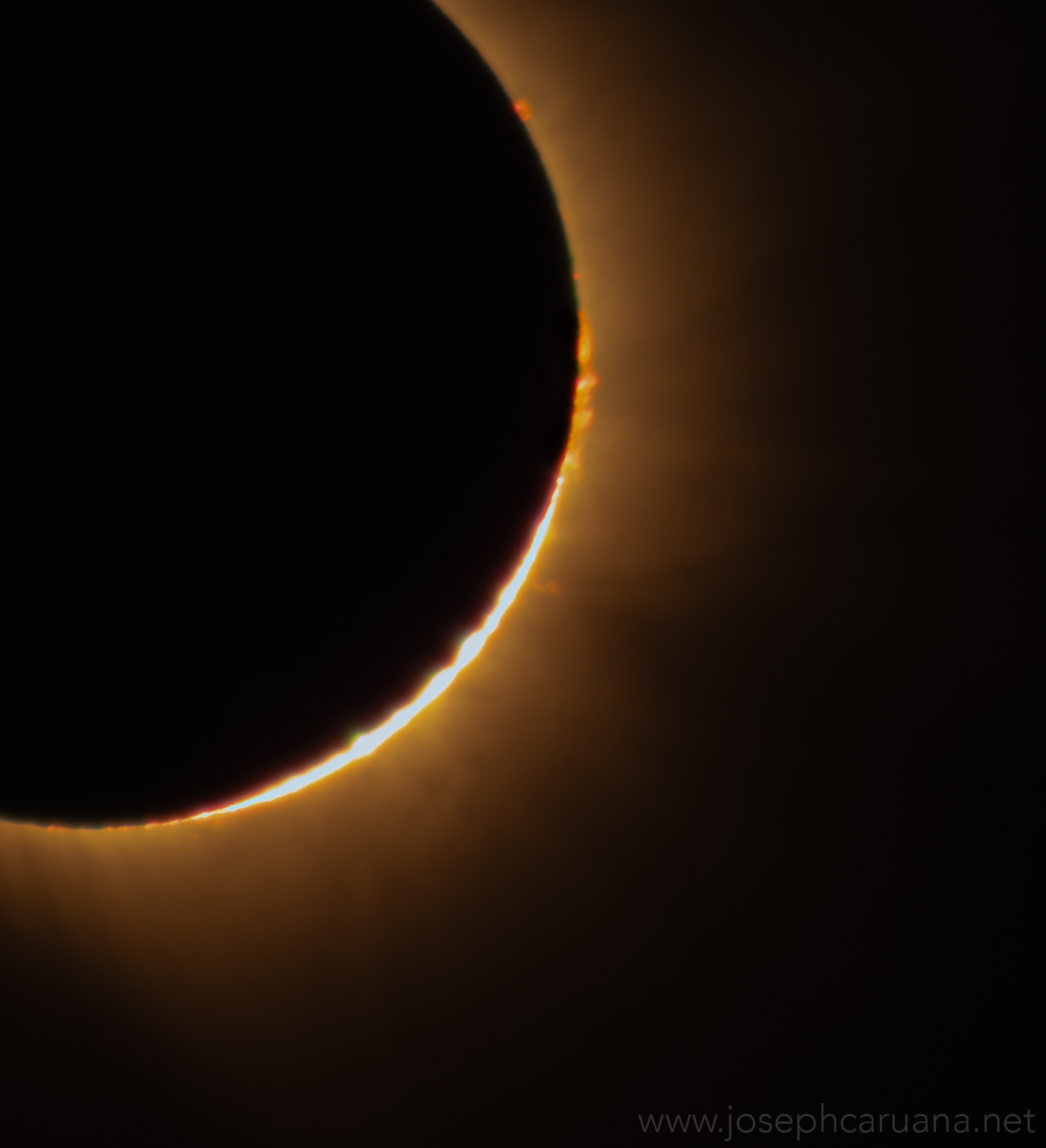
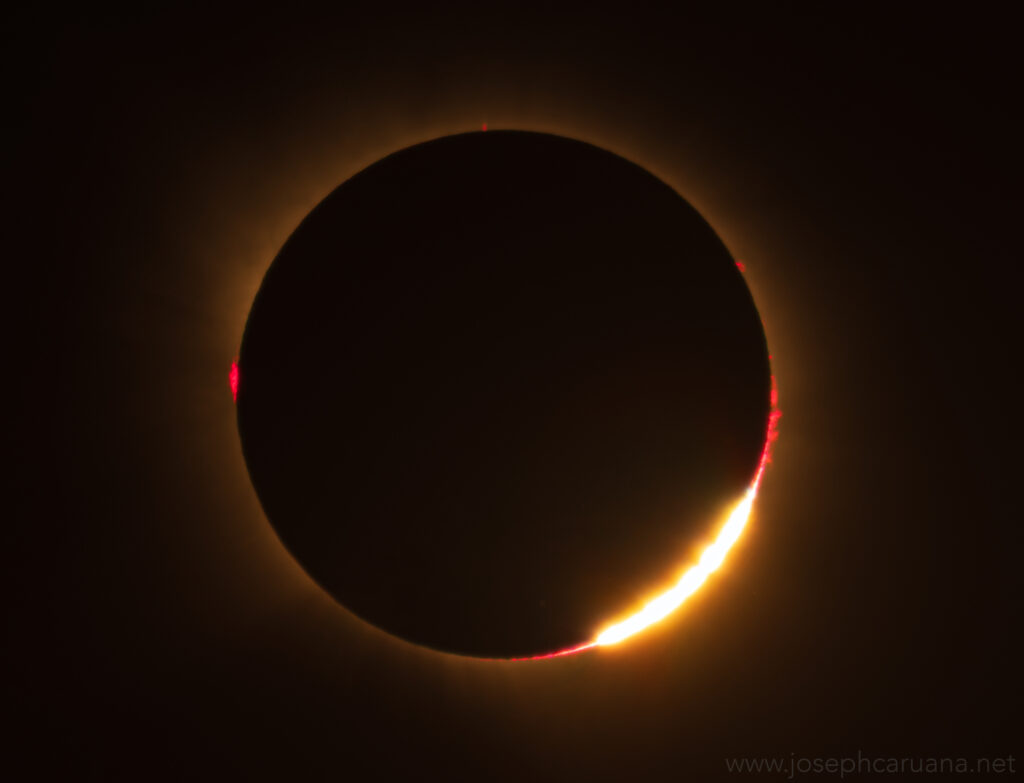
Next came the Diamond Ring effect on the other side – the signal that totality was about to end imminently.
The labelled version below identifies the same features we saw previously.
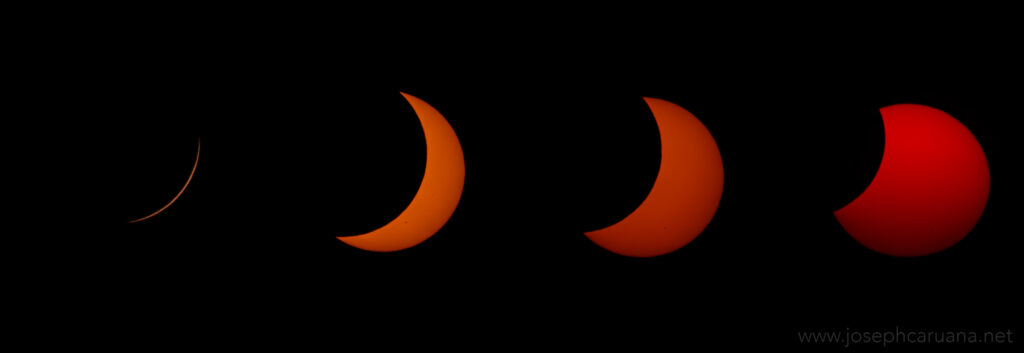
With that, totality came to an end, as the moon continued on its path, revealing more of the solar disc. I swiftly moved in front of the camera to protect the sensor once more, and put the solar filter back on. In the below images, observe how the sun is getting redder as it sets (on account of the light being filtered through a thicker chunk of our atmosphere).
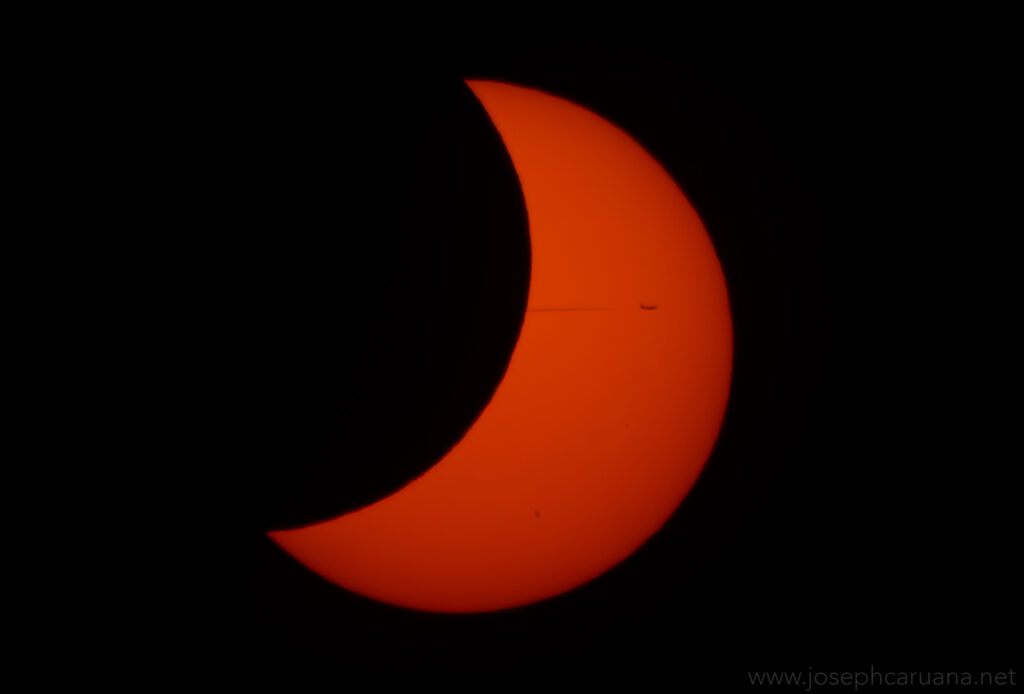
In one of the images of the partial eclipse phase, I was lucky enough to capture a plane crossing the solar disc!
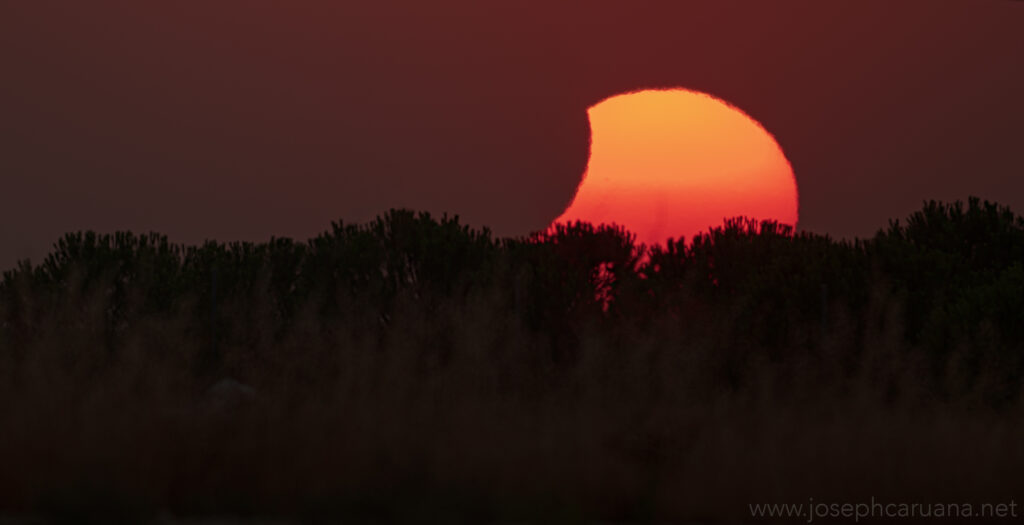
The Sun set while it was still partially eclipsed – by now considerably dimmed and reddened. A beautiful sight to behold!
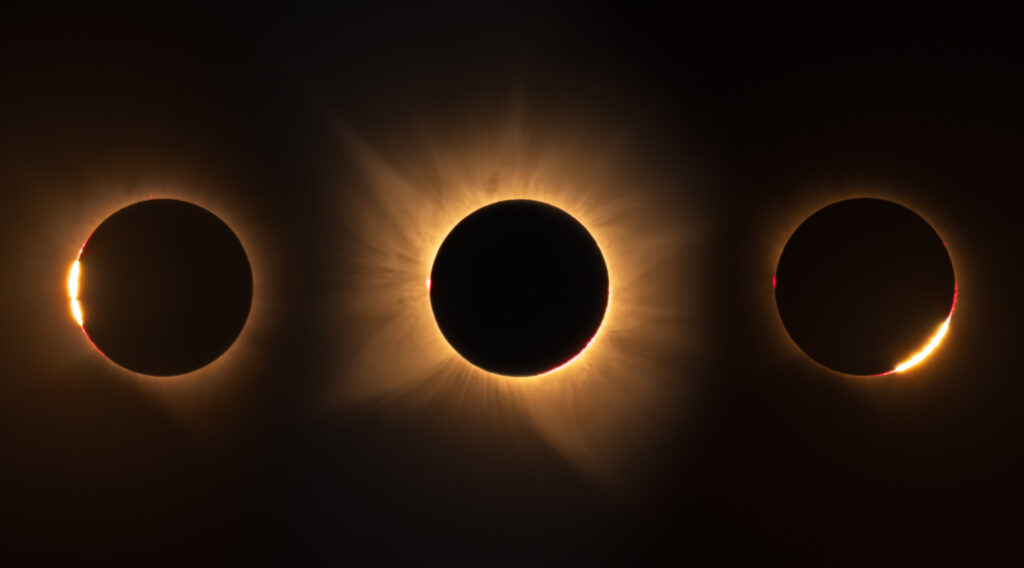
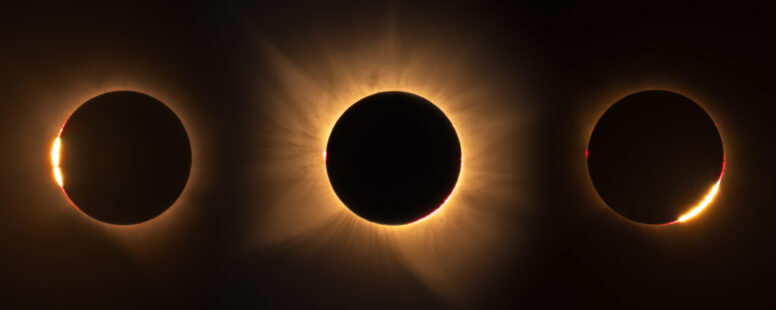
And that brings us to the end! Below is a montage of totality flanked by the Diamond Ring instances.
In summary, this having been the first total solar eclipse I’ve witnessed, I’m now completely hooked. I’ve kept thinking about how it’s possibly the most stunning natural phenomenon I’ve ever experienced. It wholly surprised me with its breathtaking beauty despite knowing, in principle, what to expect. No matter how much you’ve read about it, heard others describe it, or seen photographs and videos, the actual experience far surpasses them all, and becomes something that is forever etched in your memory.
I am especially pleased that despite the short duration of this eclipse – lasting merely a minute and a half – I managed to both photograph it and enjoy it visually. I did not wish to spend those precious moments fumbling with the camera, so I am particularly glad to have captured the images above while still taking in the spectacle with my own eyes. I guess the planning and exposure tables did pay off in the end!
The whole experience was made all the more special by the company of a wonderful group of people, to whom I am deeply grateful for the conversations, the shared excitement, the laughter, the hospitality, and, above all, the opportunity to experience it together.
*Baily’s beads are sometimes said to precede the Diamond Ring effect. This is a matter that the late NASA GSFC astrophysicist Fred Espenak (known as “Mr Eclipse”) had also written about in Sky & Telescope. The matter arises from a matter of definition: if the Diamond Ring were defined as a single Baily’s bead, then indeed it would have to come after them. However, as Espenak relates, Baily’s beads don’t exceed 5 seconds, so going by this definition, the Diamond Ring would have to be an even more fleeting phenomenon (it being the last of the beads). This conflicted with Espenak’s experience of over twenty eclipses. His view was that the Diamond Ring, in fact, came first, for he often photographed it a good ten seconds before totality, it being a “blend” of beads, or “arc of photosphere”. Espenak’s view tallies perfectly with my visual and photographic experience of this eclipse.
Thank you Joseph for that poignant commentary. A total solar eclipse is a powerful and unforgettable experience. Felt like being there, thanks to you 🙏